What are vertical AI agents?

As AI technology advances, it’s become clear that general-purpose AI often lacks the precision and depth to tackle industry-specific problems. As a result, there’s a growing demand for tailored AI solutions that address the real challenges of particular industries. This brings us to the next logical step in the evolution of AI—vertical AI agents.
What are vertical AI agents?
Vertical AI agents are AI systems tailor-made for specific tasks or workflows in a particular domain or industry. Unlike general-purpose AI models like ChatGPT, which are designed for a broad use across fields, vertical AI agents are customized to address specific challenges and optimize workflows within a particular vertical sector.

Automate customer service with AI agents
Key characteristics of vertical AI agents
In addition to being AI agents that think and act autonomously, vertical agents have a set of distinct characteristics that make them suitable as specialized tools.
The key characteristics of vertical AI agents include:
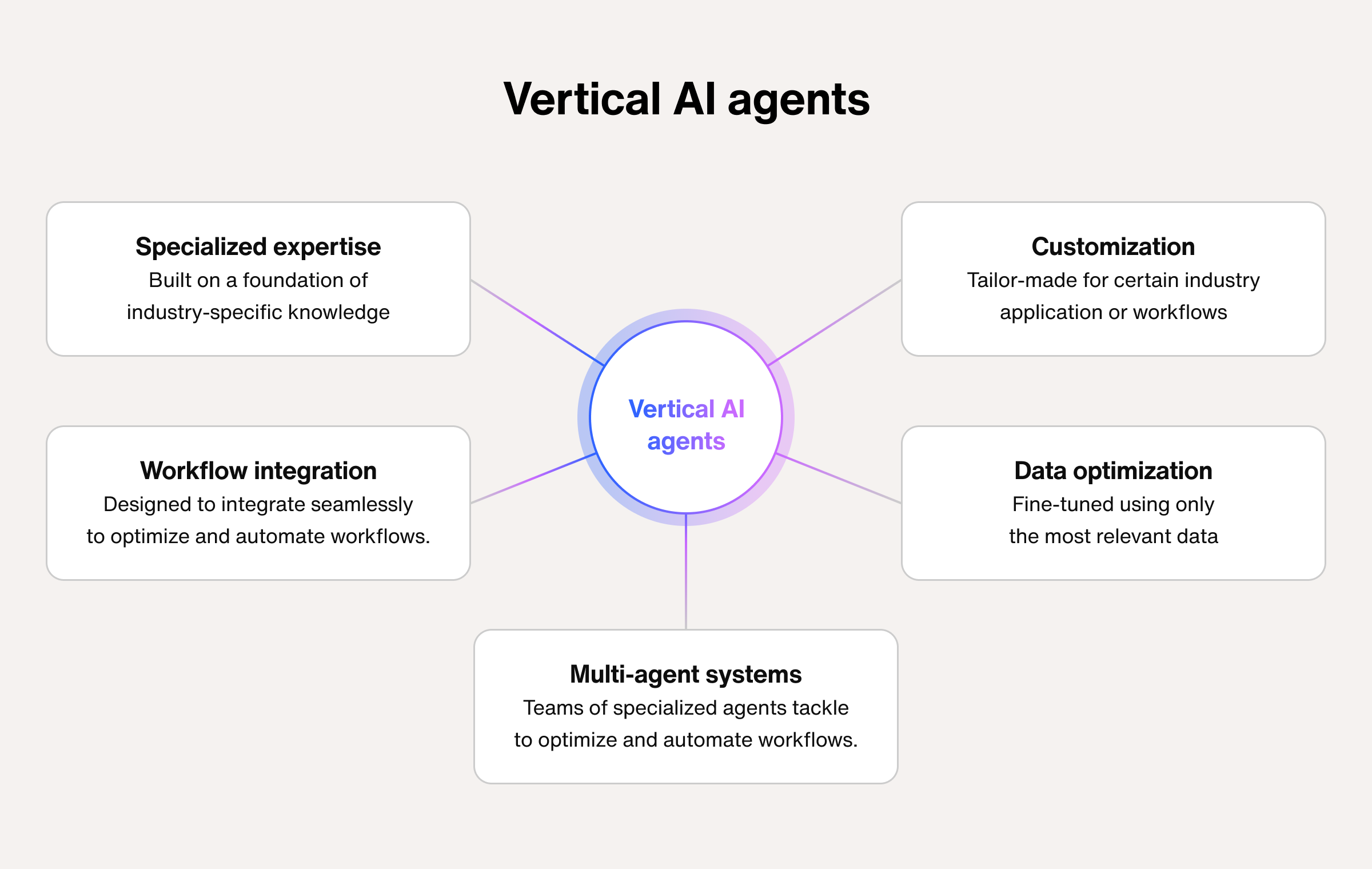
Specialized expertise: Vertical AI agents are built on a foundation of deep, industry-specific knowledge. Designed to understand the nuances of a specific industry or user, they can execute specialized tasks on their own, such as legal contract analysis, medical diagnostics, financial risk assessment, and more.
Customization: Vertical AI agents aren’t just adapted to a particular industry, they’re originally built for specific industry applications and workflows. This level of fine-tuning enables them to interpret and act on industry-specific datasets with unmatched efficiency and precision.
Data optimization: Vertical AI agents are fine-tuned using only the most relevant first and third party data. This makes them far more accurate, reliable, and effective for niche applications than AI tools trained on generic information.
Workflow integration: Vertical AI agents are designed to integrate with existing systems and tools, allowing a business to optimize workflows without disrupting them.
Multi-agent systems: The true power of vertical AI agents lies in multi-agent systems, where a team of specialized agents work together to tackle complex challenges, and even achieve end-to-end AI workflow automation.
Why do vertical AI agents matter?
As businesses face increasingly complex challenges in their industry, vertical AI agents have emerged as a customizable solution with utility-specific capabilities required to solve real business problems.
By combining specialized expertise with autonomous decision-making, vertical AI agents are poised to redefine operational efficiency and automate entire processes that have been too complex until now.
Here’s how vertical AI agents benefit a business:
Solve complex problems: Tackle complex business problems with a combination of domain-specific expertise, autonomous decision-making, and real-time data, offering a level of precision that general-purpose AI can’t match.
Improve productivity: Streamline operations and automate intricate tasks using a tailor-made solution for unique environments or industry applications that drives greater productivity and efficiency.
Increase competitiveness: Get a competitive edge using advanced, tailored solutions that improve decision making and operational effectiveness by automating tasks within a specific domain.
Realize ROI faster: Achieve benefits and measurable results in less time with custom solutions that fit seamlessly into AI agentic workflows, allowing for rapid employee adoption and faster realization of value.
Enhance decision making: The niche knowledge base of vertical AI agents simplifies and improves the quality of their decision making, leading to superior customer interactions, unique insights, and novel solutions to business problems.
Accelerate implementation: Due to their specialized functionalities, vertical AI agents can be deployed more quickly and integrate seamlessly into existing systems.
How are vertical AI agents different from horizontal AI agents?
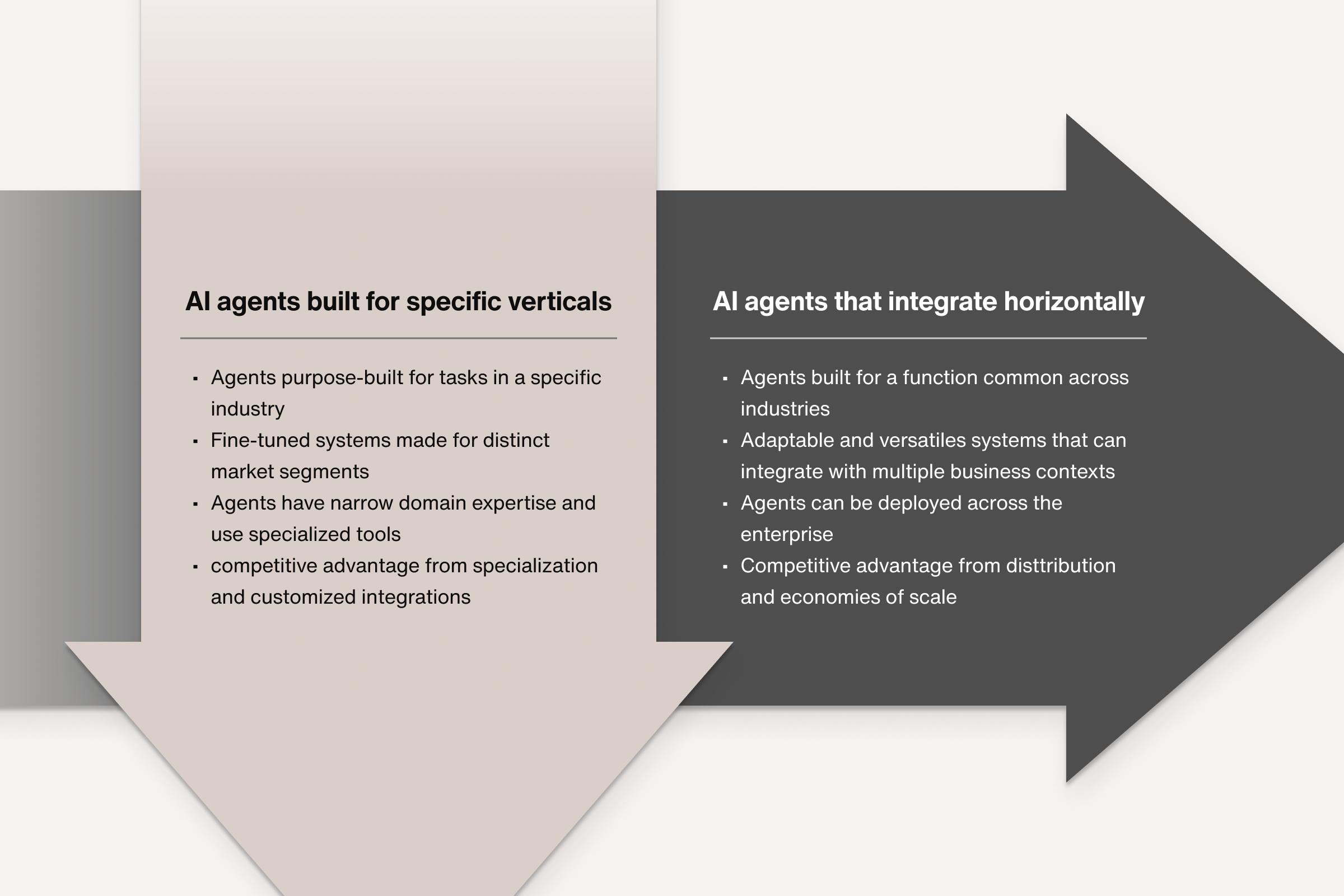
Vertical AI agents bridge the gap between the general-purpose AI tools that have emerged since ChatGPT and the specific demands of a certain industry. Typically built on a large language model (LLM) of domain-specific intelligence, vertical AI agents are customized with targeted prompt engineering and fine-tuned with industry-specific datasets.
Horizontal AI agents, on the other hand, are general-purpose systems that can be applied across various industries for a broad range of tasks. For example, horizontal AI can include natural language processing models like ChatGPT, AI chatbots, or predictive analytics—all of which are useful in many contexts. Adaptable to multiple industries and uses, horizontal AI can also focus on a particular business unit, such as AI for cybersecurity or AI for customer service.
In short, horizontal AI offers broad applicability and versatility across multiple industries and tasks, while vertical AI is a tailored solution to a niche problem or process in a specific industry.

Boost CSAT with proactive AI customer service

Reinvent CX with AI agents
Getting started with vertical AI agents
It's never been easier or more cost-effective to build a vertical AI agent. If you're considering how to maximize AI in your organization, Delight can help.
Our team of friendly AI experts can help you build, manage, and optimize a custom AI concierge or any other application across the entire AI lifecycle.
To learn more, contact sales or explore our approach to building an AI agent.